
Brain Health and Alcohol Use: The Science is Getting Clearer
This is the first in 3-part series on alcohol, aging, and brain health.
Recent research on alcohol use has shifted physicians' views on the safety of alcohol consumption. This newer and more rigorous research is increasingly challenging the idea of alcohol as a net positive, or even as an innocuous part of culture and social lives.
While everyone should understand what the research means, older adults need to pay special attention. Alcohol use impacts the systems that affect our ability to age healthily: It can negatively affect our heart, brain, sleep, balance, and make us more likely to develop cancer.
But alcohol is also often the centerpiece of one of the six behaviors critical to brain health as we age – socialization. And it can be a crutch for older adults who are lonely, magnifying the potential for brain injury.
In this 3-part blog series, we’ll look at the latest research on alcohol and health, the hidden dangers of drinking as we age, and ways to find social activities that don’t revolve around alcohol.
But first, let’s address how drinking came to be labeled as healthy.
The French Paradox and the ‘Alcohol is Healthy’ Myth
In 1991, the television news program “60 Minutes” aired the “The French Paradox” episode, which discussed a study that found an interesting correlation: The French, despite their love of brie cheese and butter (i.e., saturated fats), had a lower rate of heart attacks compared with countries that consumed a similar amount of animal fats.
60 minutes interviewed the researcher who had published the study in The Lancet with a title bound to catch our attention: "Wine, alcohol, platelets, and the French paradox for coronary heart disease". It was a correlational study that didn’t – and still doesn’t, 35 years on – establish definitive causation. It turns out you would need to drink 500 liters of red wine a day to get the resveratrol needed to protect the heart.
But the French Paradox wasn’t the only research that gave us the idea that alcohol in moderation was a good thing.
For decades, studies have suggested that moderate alcohol intake could not only protect the heart but also reduce diabetes risk and even help you live longer. Newer research tells a different story, according to an article in the Stanford Report.
Previous studies were survey-based. Longtime non-drinkers were lumped in with those who had to quit because of alcohol-related health problems. “That skews the data, making moderate drinkers look healthier by comparison,” noted Keith Humphreys, PhD, a Stanford professor of psychiatry and behavioral sciences.
Newer research has also uncovered a link between alcohol use and cancer.
According to the American Association for Cancer Research, “excessive levels of alcohol consumption increase the risk for six different types of cancer and are linked to more than 200 diseases. In the United States, 5.4 percent of cancers were attributed to alcohol consumption in 2019, the most recent year for which data are available.”
How Alcohol Impacts Brain Health
So it’s not helping our heart, and it is increasing our risk of cancer, what about our brains?
The news isn’t all that great there either.
Recent large-scale studies using genetic analysis and large datasets now suggest alcohol may increase dementia risk even at low levels.
A major analysis involving 550,000 adults found that higher alcohol consumption increased lifetime dementia risk. Each threefold increase in alcohol consumption was associated with about a 15% higher dementia risk. Researchers concluded there is no evidence that moderate drinking protects against dementia.
“These findings challenge the notion that low levels of alcohol are neuroprotective and suggest that public health efforts to reduce alcohol use disorder could significantly lower dementia incidence,’’ the study authors said. “Halving the population prevalence of alcohol use disorder may reduce dementia cases by up to 16%, highlighting alcohol reduction as a potential strategy in dementia prevention policies.”
Other studies have examined drinking in different ways, with similar results. Heavy drinking accelerates brain aging and is linked to executive function impairment.
Rethinking How We View Alcohol Consumption
"Alcohol was never a health food," explains Amy Sasser Sorrells, founder and executive director of Reframe Rethink Restore, a nonprofit working to modernize how alcohol is understood and taught. Through its Alcohol Use Spectrum© framework, the organization encourages people to move beyond the myth that alcohol is either a problem or it isn't and instead understand alcohol use as a spectrum of risk, health, and dependency.
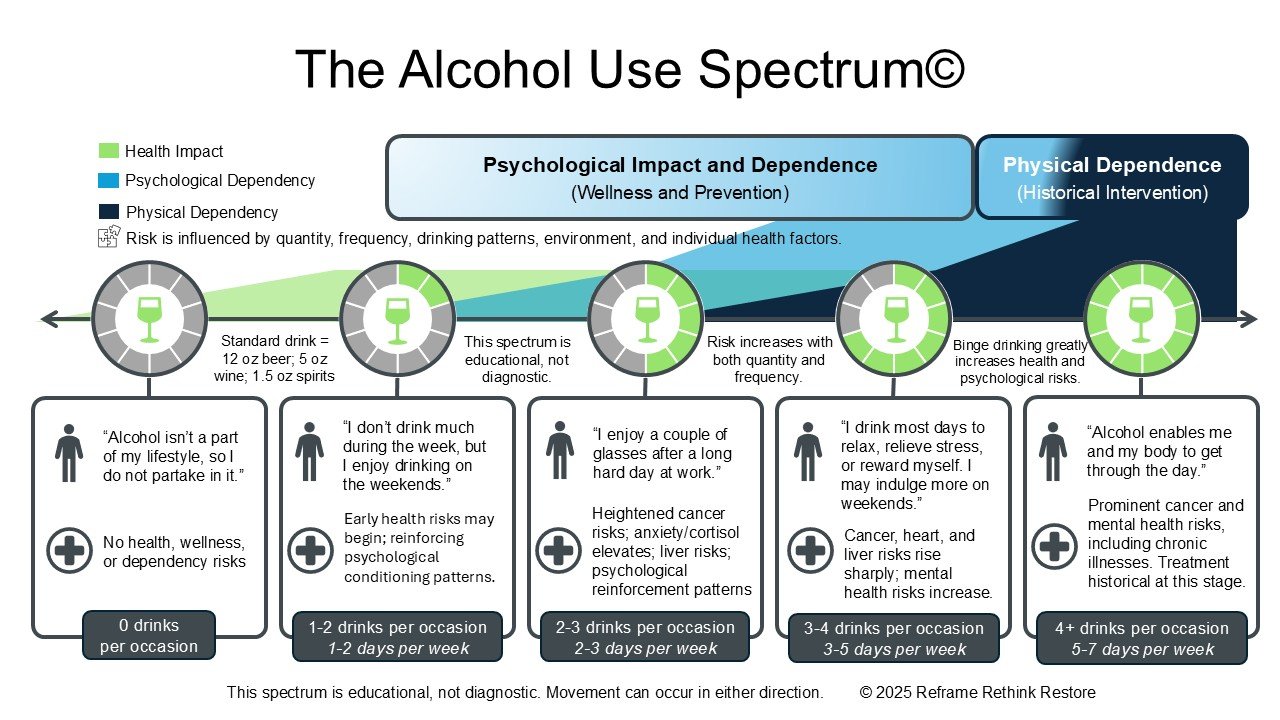
The Reframe Rethink Restore organization looks at alcohol use as a spectrum.
"Alcohol remains one of the most normalized behavioral health risks in the United States, yet we still tend to talk about it in binary terms — you either have a problem, or you don't. Modern research tells a different story. Psychological conditioning, health impacts, and risk often begin much earlier than most people realize."
We will take a look at that in our next blog.
Discover all the ways Mindr teaches you to keep your brain healthy.
